A Friend Plus

The problems in mentor-mentee relationship in our society has been discussed from an experience based approach. Mentors should become special friends to the mentees and might eventually rise to the level of friend, philosopher and guide. However, all seeds do not make big trees. So, a friend plus position for the period of cooperation is good enough. Mentor and mentees may be close in age like classmates or they may have age gap of one or two generations. Mentees like to see mentors to be slightly advanced co-thinker of the problems faced by them.
Continue reading

Mentor-Mentee Relationship

The key to success is for the mentor to be extremely generous to ensure that the mentee has all the support (s)he needs for his/her research. This includes ensuring a hassle-free research environment, administrative support and access to resources (including papers, talks and visits to conferences). Given the uncertainties in research, it is important that the mentee is guaranteed such support during his/her first few years.

Continue reading

Pandemic and Pedagogy

It is important for a journalist to be equipped with a moral compass to have a strong discerning sense of what is right and wrong that goes beyond political propriety. Take the case of using a hidden camera. Normally it is unethical to use one, but a sting operation may be warranted in the larger public interest when it becomes legitimate, even if not necessarily legal in the strict sense.

Continue reading

Disability, Difference and Inclusive Classroom: Some Challenges

This article discusses the problems that persons with physical and cognitive challenges confront on account of exclusivist attitudes in academic institutions.  It focuses in particular on the classroom situation and attempts to bring to the fore how unpreparedness of teachers and students, the absence of adaptive teaching curriculum and teaching techniques, the absence of empathy and active listening, the unavailability of access to adequate learning material can lead to alienation of the students with physical and cognitive difference which ultimately leads to their complete withdrawal.

Continue reading

Educated by the Pandemic

The science of coping with the pandemic progressed far faster than  anyone could hope for, but socio-political and cultural worlds have struggled to keep pace.  Culture and politics have clashed with science, leaving everyone worse off. We are nowhere near the final chapter of this real-life drama.

Continue reading

The Impact of Virtual Labs during the Pandemic Period

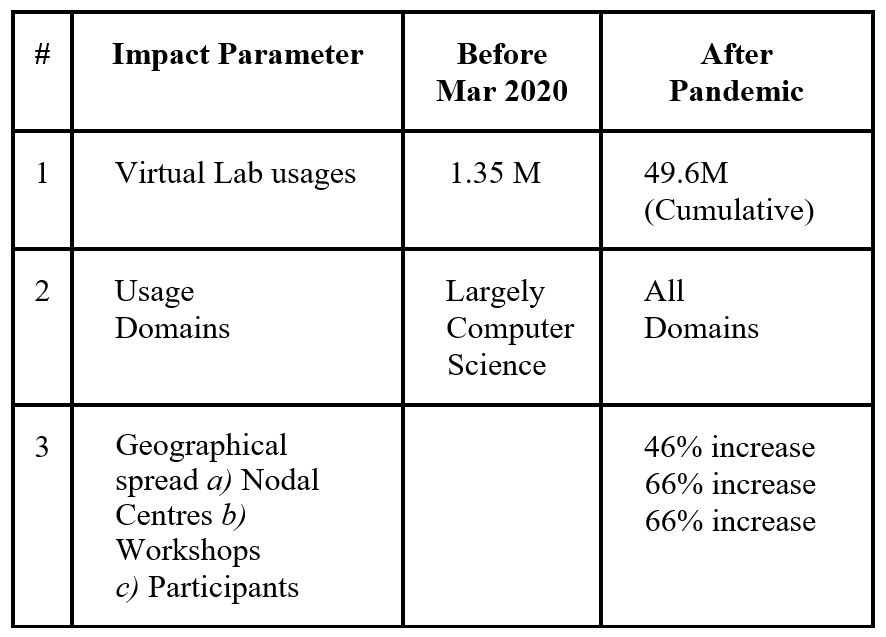
The need to do college laboratory experiments in science and engineering remotely due to the COVID 19 Pandemic became necessary for the entire student community, from March 2021 onward. The Virtual Lab repository built under the NMEICT Program of the Ministry of Education, Government of India, was leveraged for use by students to do simulated experiments. The Virtual Labs made a substantial impact and was used by over 7.0M users to meet their curricular needs. This chapter describes the salient features of the impact and how this impact can be sustained through specific initiatives.

Continue reading

Teaching and Caring

A teacher’s act of teaching is moderated by the experience of seeing the class and being-seen by the class. As teachers, we develop a fine-tuned antennae that can sense the mood of the class. We know when the students are getting bored or restless, or when they get a spark thinking through something we have said.

Continue reading